
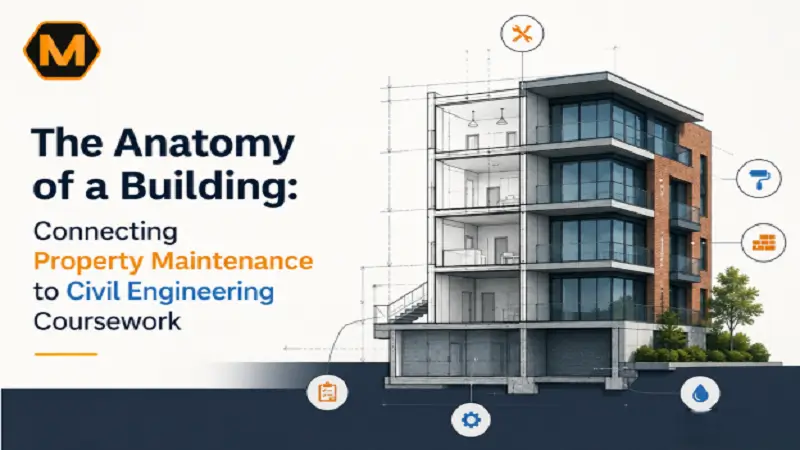
The lifecycle of any structure is divided into two distinct phases: creation and survival. In a traditional university curriculum, the vast majority of academic focus is directed toward the first phase. Students spend countless hours calculating bending moments, analyzing soil load-bearing capacities, and drafting flawless digital blueprints. However, once the ribbon is cut and the construction crews leave the site, the real test of engineering begins. A building is not a static monument; it is a dynamic, living system that immediately begins to interact with, and degrade under, environmental forces.
For undergraduate students pursuing degrees in built environments, understanding the long-term survival of a structure is just as critical as knowing how to erect it. Property maintenance is not merely a collection of cosmetic fixes or routine chores; it is the practical application of civil engineering theories. When a facility manager inspects a building for concrete spalling, monitors structural shifting, or designs a preventive waterproofing strategy, they are actively managing the physical forces that students calculate on paper. Bridging the gap between the classroom and field maintenance is essential for developing holistic engineering skills.
1. Structural Integrity and Foundation Maintenance
The foundation is the most critical element of any physical asset, bearing the entire dead load of the structure and the live loads of its occupants. In the classroom, professors emphasize soil mechanics, stress distribution, and geotechnical parameters. On the ground, however, structural maintenance teams deal with the real-world consequences of these formulas. Foundation settlement, soil erosion, and changing water tables can introduce unintended stresses that threaten the entire building framework.
[Soil Movement / Hydrostatic Pressure]
│
▼
[Foundation Micro-Cracks]
│
▼
[Moisture Ingress & Rebar Oxidation]
│
▼
[Structural Failure / Spalling]
When moisture seeps into concrete foundations, it triggers a destructive chain reaction. The internal steel reinforcement bars (rebars) begin to oxidize, expanding up to several times their original volume. This internal pressure causes the surrounding concrete to crack and break away, a phenomenon known as spalling. Analyzing these physical failures requires a deep grasp of fluid mechanics, structural dynamics, and advanced materials science. Because identifying the root causes of real-world architectural failures can be incredibly time-consuming, turning to specialized civil engineering assignment help allows students to master the complex theoretical mathematics behind building inspections while keeping up with their rigid coursework demands. Understanding how environmental stressors alter structural performance ensures that future engineers design buildings that are not only structurally sound on day one but are also resilient over a fifty-year lifespan.
2. The Mechanics of Water Ingress and Building Envelopes
A building envelope acts as the primary barrier between the controlled interior environment and the unpredictable external elements. Roofs, external cladding, windows, and waterproofing membranes must function as a cohesive system to repel water. Water ingress is one of the most destructive forces in property care, capable of compromising structural safety, destroying interior finishes, and fostering toxic mold growth that threatens public health.
From an engineering perspective, water management is a continuous battle against hydrostatic pressure, capillary action, and gravity. For example, flat roof systems are never truly flat; they must be designed with precise micro-slopes to guide rainwater toward drainage points. When a drainage system fails due to poor maintenance or inadequate design calculations, standing water creates significant dead weight on the roof deck, leading to structural deflection and accelerated material degradation.
3. Preventive Care vs. Reactive Engineering
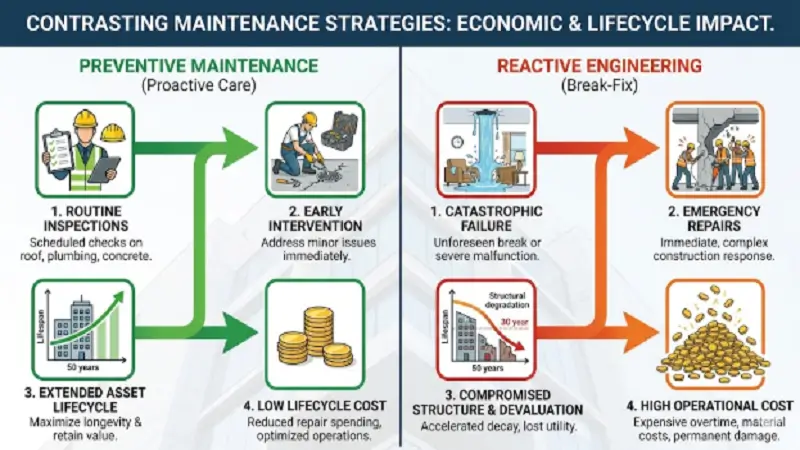 In asset management, maintenance strategies generally fall into two categories: reactive maintenance (fixing things after they break) and preventive maintenance (scheduled interventions to prevent failure). The economic and structural advantages of preventive care are massive, yet many property owners wait for a critical failure before taking action.
The following table outlines the clear operational differences between these two philosophies across standard property components:
| Building Component | Preventive Maintenance Approach | Reactive Engineering Consequence |
| Foundation & Concrete | Annual crack sealing and concrete structural monitoring | Foundation underpinning, structural leveling, and high repair costs |
| Roofing System | Bi-annual clearing of drainage systems and membrane inspections | Water ingress, ruined insulation, and complete roof deck replacement |
| HVAC & Ventilation | Regular filter changes, fan balancing, and coil cleanings | System burnout, poor indoor air quality, and high emergency replacement costs |
| Plumbing & Drainage | Hydro-jetting main lines and testing pressure valves | Burst pipes, localized flooding, and significant structural water damage |
4. Documentation, Project Management, and the Academic Workload
Successfully managing a modern facility requires an immense amount of documentation, including structural blueprints, building logs, environmental impact reports, and maintenance schedules. Similarly, the academic journey of an engineering student is defined by intense technical reporting, data analysis, and laboratory case studies. The sheer volume of technical writing required can often overwhelm undergraduates, who must split their energy between learning advanced field methodologies and drafting flawless academic prose.
When student schedules become unmanageable due to simultaneous lab deadlines and exams, seeking external academic support becomes a logical step for time management. Utilizing Myassignmenthelp can give busy students the necessary room to balance their practical field training with heavy writing demands. Delegating formatting or research reviews to a dedicated assignment help ensure that students can focus their core attention on mastering physical engineering principles without sacrificing their overall grade point average. Writing structured reports is a core professional skill, and learning how to manage academic resources effectively mirrors the project delegation skills required of a senior project manager in the field.
5. Sustainability and the Future of Facility Maintenance
Modern property care is evolving rapidly due to global sustainability initiatives and stricter green building codes. Today’s civil engineers must design with the building’s operational carbon footprint in mind. This means that property maintenance now includes optimizing energy efficiency, managing waste systems, and retrofitting older structures with smart technologies.
[Smart Sensor Deployment]
│
▼
[Real-Time Data Collection]
│
▼
[Predictive Maintenance Actions]
│
▼
[Lower Energy Use & Extended Lifespan]
By installing Internet of Things (IoT) sensors within structural elements, facility managers can monitor thermal performance, moisture levels, and structural vibrations in real time. This data allows for predictive maintenance, meaning components are repaired exactly when needed, saving energy and materials. As an undergraduate student, viewing property care through the lens of data analytics and sustainability prepares you for a shifting industry where long-term resource preservation is valued just as highly as initial construction speed.
Frequently Asked Questions (FAQ)
Q.1 How does property maintenance connect directly to what I learn in civil engineering classes?
Ans: Property maintenance is the real-world validation of engineering theory. Concepts like concrete spalling are direct applications of material science and oxidation chemistry. Foundation settling applies soil mechanics, and roof drainage design relies on fluid mechanics. Studying how buildings fail or degrade helps you design better, more resilient structures in your coursework.
Q.2 Why is preventive maintenance considered superior to reactive repairs in asset management?
Ans: Preventive maintenance addresses minor issues—like sealing a small hairline crack or clearing a roof drain—before they escalate into catastrophic failures. As shown in our comparison table, reactive repairs are significantly more expensive, disrupt building operations, and can permanently compromise the structural safety of the asset.
Q.3 What are the main causes of structural degradation in older buildings?
Ans: The primary driver of structural degradation is water ingress. When moisture penetrates concrete or masonry, it rusts internal steel reinforcements, leading to concrete spalling and weakened load-bearing elements. Other major factors include ground shifting, thermal expansion and contraction cycles, and prolonged lack of routine surface sealing.
Q.4 How can smart technology help reduce a building’s operational carbon footprint?
Ans: Smart technologies, such as IoT sensors and automated building management systems, track energy usage, identify insulation gaps, and detect water leaks early. By analyzing this data, facilities can optimize their heating, cooling, and ventilation systems, significantly reducing waste and lowering the building’s overall environmental impact.
About The Author
My name is Ruby Walker, and I am an academic consultant and senior digital content strategist at MyAssignmentHelp. With a deep passion for bridging the gap between theoretical university concepts and real-world industrial practices, I specialize in crafting comprehensive, research-driven educational guides for undergraduate students.See More